“BU’s Support Means More Pediatricians. And That Means Healthier Children.”
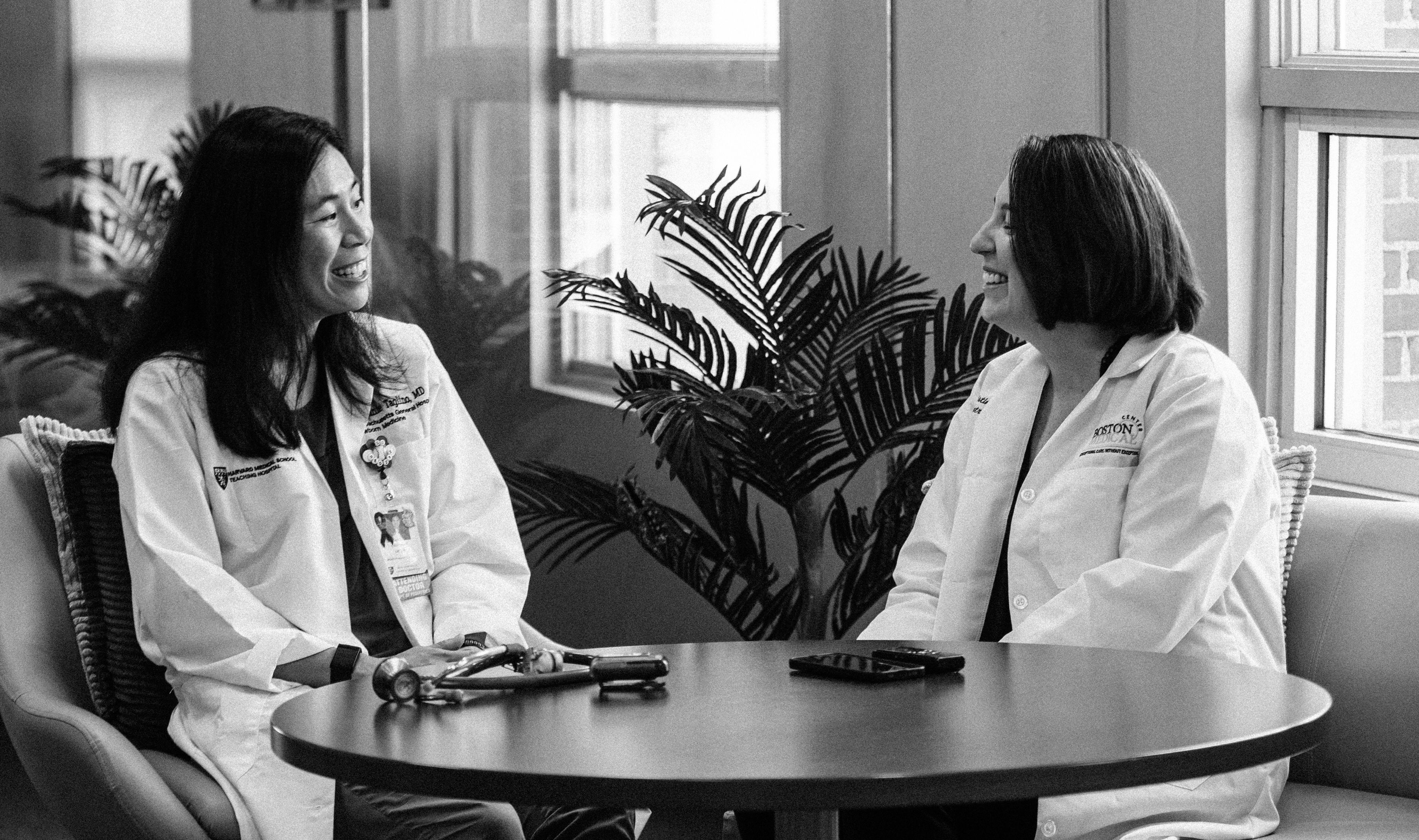
Above: Stephanie Taglino, a Karp Family Scholarship recipient, is a pediatrician and newborn medicine hospitalist for Mass General Brigham. Christine Cheston is the Karp Family Professor and clinical associate professor of pediatrics in hospital and newborn medicine at our Chobanian & Avedisian School of Medicine. She is program director of the Boston Combined Residency Program and medical director of the Newborn Nursery at Boston Medical Center.
Because of a national shortage of pediatricians, many children wait too long to see a doctor and can’t get the care they need. Pediatricians typically earn much less than those in other specialties, so medical students with loans to repay often choose more lucrative paths.
Boston University Trustee Emeritus Stephen Karp (CAS’63, Hon.’23) decided to do something about it. His Karp Family Foundation endowed scholarships with $3.5 million, to reduce the debt of the best Chobanian & Avedisian School of Medicine students who choose pediatrics.
Pediatrician Stephanie Taglino (Sargent’15, CAMED’19) tells Christine Cheston, Karp Family Professor and a clinical associate professor of pediatrics, why more people should know about the Karp Family Scholarships. (Cheston’s professorship is also funded by the Karp Family Foundation.)
Cheston says she has been concerned about how the pediatrician shortage might affect children and that Karp’s targeted gift could enable more students who are interested to join the field.
Dr. Stephanie Taglino and Dr. Christine Cheston in conversation.
CHRISTINE CHESTON: How did getting the scholarship affect you?
STEPHANIE TAGLINO: Moving into pediatrics, a specialty in which one is traditionally compensated lower than adult-medicine colleagues, was a little daunting. The prospect of graduating from medical school with a significant loan burden and wondering whether that was going to play a significant role in career decisions down the line was daunting. The scholarship allowed me freedom to choose the path I wanted, as opposed to what would make me more financially secure.
What are the best parts of being a pediatrician?
One is watching a child grow. Even in two and a half years [as an attending physician], I’ve had children I’ve taken care of in the hospital as a newborn hospitalist who then come to my practice. I’ve watched them grow from a baby who’d barely eat and had trouble gaining weight to this two-year-old who’s running around, starting to learn cause-and-effect, how to talk, and how to walk. I’m playing a role in these kids’ lives. That’s very special—and it’s so fun.
And the challenges you face day-to-day?
The number one thing is the mental health crisis in our youth. The amount of mental health care that I see as part of my practice as a general pediatrician has increased exponentially. The amount of ADHD, anxiety, and depression that I see is a lot more than I was expecting. That has required learning on the fly. There’s a huge resource gap between what the pediatric population needs and what we have. Adults talk every day about how hard it is to find an adult therapist. Trying to find a pediatric therapist is even harder.
This summer, there have been times you haven’t been able to welcome new patients into your practice.
We’ve had two doctors retire. To serve the patients that we already had, we had to close our practice to new patients. We try to make exceptions when the need is great for our patients on MassHealth, who can only be seen by certain institutions. We end up double-booking. I worked two extra clinic sessions last week to see the patients who needed to be seen. And it feels terrible when we have to tell families, “Call us again in September.” I think we’ll be able to open again, but we are bursting at the seams. And we know we’re not the only practice dealing with this. Families tell us they’ve called six different practices and no one is taking new patients. They’re in disbelief that this could be happening in one of the highest doctor-per-capita cities in the world.
Funds for Karp Family Scholarships awarded
Chobanian & Avedisian School of Medicine students matching to pediatrics receiving the scholarship
Can you give us an example of a patient you worried about not being able to get the care they needed?
A patient and his mom immigrated from the Dominican Republic because he had spina bifida as a young child. He has spastic paraplegia, is in a wheelchair, and requires a catheter. He is a ten-year-old with a lot of medical challenges, and if he can’t see that specialist he needs, his condition could deteriorate quickly, leading to a prolonged hospitalization—which happened earlier this summer. Fortunately, he has been discharged and is doing well. But if kids can’t be seen in a safe, timely outpatient fashion, they often end up in the hospital with complications from something because care has been delayed.
The scholarship helped you decide to work in an academic medical center as opposed to private practice. Why is that important?
We have so many children that are on state health insurance, and the providers their insurance will cover are a much smaller group. The academic medical centers like Boston Medical Center and Mass General Brigham have to take those patients. And if there is a shortage of pediatricians, the wait times get longer and longer. These are the kids who are already disadvantaged socioeconomically, and now they’re even further behind. It pulls them out of school, out of living and doing the things kids need to do—playing outside, playing with friends—in order to develop into healthy adults. That’s why we need more pediatricians. More doctors would mean shorter wait times and better health outcomes.
“More doctors would mean shorter wait times and better health outcomes.”—Stephanie Taglino
How could support like this scholarship address the shortage of pediatricians?
People are thinking, “How am I going to pay back all these loans that I had to take out for this education?” And they know that pediatrics is a lower-paying specialty, although an extremely fulfilling one. Knowing there is a financial safety net for them could enable them to join a field in which they’re needed and would be really happy. I’m grateful that someone recognizes the important work that our specialty accomplishes and is prioritizing the health of future generations.
What would you say to medical students today?
Don’t be afraid to choose pediatrics. It is the most fun specialty, the most joy in your work. The scholarship exists. Hopefully, that will allow you to follow your passion. And more pediatricians means healthier kids.